Thursday, 8 May 2014

Tuesday, 29 April 2014
Monday, 28 April 2014


Tuesday, 1 April 2014
Script abbreviations
SCRIPT ABBREVIATIONS
ELS extreme long shot
MLS medium long shot
LS long shot
MS medium shot
MCU medium close-up
CU close-up
ECU extreme close-up
OS over-the-shoulder shot
2-S or 3-S two-shot or three-shot
POV point of view shot
ZI or ZO zoom in or zoom out
INT interior
EXT exterior
SOT or SOF sound on tape or sound on film
BG background
SFX or F/X special effects (can be either sound or visual)
VO voice-over
OSV off-screen voice
DIS dissolve
We will use these on our storyboard when planning our film opening construct.
MLS medium long shot
LS long shot
MS medium shot
MCU medium close-up
CU close-up
ECU extreme close-up
OS over-the-shoulder shot
2-S or 3-S two-shot or three-shot
POV point of view shot
ZI or ZO zoom in or zoom out
INT interior
EXT exterior
SOT or SOF sound on tape or sound on film
BG background
SFX or F/X special effects (can be either sound or visual)
VO voice-over
OSV off-screen voice
DIS dissolve
We will use these on our storyboard when planning our film opening construct.
Synopsis for Hood
The hooded man; with no identity. Nothing to identify him but a tag on his wrist from an Institution for Mental Health located far north of his tragic and savage rampage. His name; long lost by the insanity that shrouds his mind.
Detective John Smith is put on an unusual case; a string of scarce and brutal murders throughout the city of Bristol. The only thing that links the murders is the angelic insignia carved into the each of the victim’s chest. When Detective Smith makes the link and digs deeper into the mystery of the hooded killer; his life begins to spiral out of control as he becomes one of the targets chosen by the unidentified hooded escapee.
With everything to lose and his inquisitive mind as his only weapon, John Smith begins to look into the history of each of the Hood’s killings, trying to figure out the identity of the serial killer before he threatens the people he cares for most– his family.
Friday, 28 March 2014
Risk Assessment
Risk Assessment
It’s important to do a risk
assessment because it means we can highlight and avoid possible risks whilst
shooting.
One of the main risks whilst
shooting our opening to our movie was that we used a knife. Whilst using the
knife we made sure that we were being supervised by a responsible adult to make
sure that we were using the knife safely.
We also ensured we knew where the
first aiders were on the site and our teachers were able to supervise us.
The first aiders that were on hand were Mrs trail and Mrs Cron and were only
downstairs in the building.
By George
Tuesday, 11 February 2014
Q6: What have you learnt about technologies from the proccess of constructing this product?
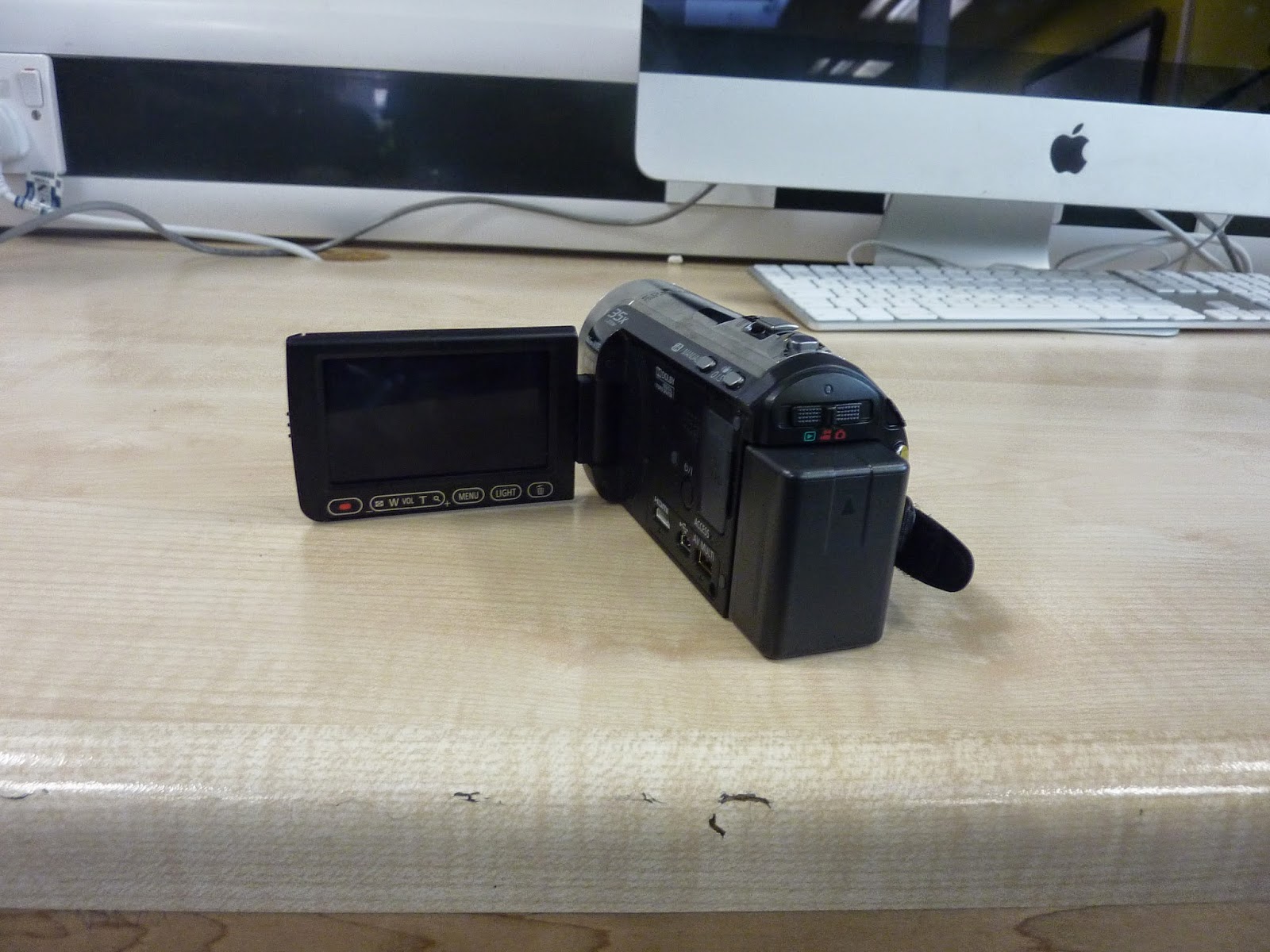
To film both our movie and our preliminary task we used a Panasonic HSD60 camcorder. Recording was a new thing to all of our group as we have never had to film anything with a real camcorder.
The zoom feature helped us in creating shots such as our close ups. This helped us save time and helped us improve the quality of our film.


 We also used a variety of equipment/technology to edit and produce our movie from the raw footage we have used some of the things that we have used include, garage band, IMovie and the apple mac's. Using the apple mac's made it easy to put the movie together in IMovie as we could easily cut and place other shots into place that we had to go back and re-shoot. With IMovie, we could use some very simple edits to enhance the look of the shots.
Using Garage band, to create our background music, was a challenge as there were a limited amount of sounds to choose from. But putting the sounds together and bind them took a while as it was hard go get the sound how we wanted it.
We also used a variety of equipment/technology to edit and produce our movie from the raw footage we have used some of the things that we have used include, garage band, IMovie and the apple mac's. Using the apple mac's made it easy to put the movie together in IMovie as we could easily cut and place other shots into place that we had to go back and re-shoot. With IMovie, we could use some very simple edits to enhance the look of the shots.
Using Garage band, to create our background music, was a challenge as there were a limited amount of sounds to choose from. But putting the sounds together and bind them took a while as it was hard go get the sound how we wanted it.


The zoom feature helped us in creating shots such as our close ups. This helped us save time and helped us improve the quality of our film.
We also used additional equipment such as the tripod, we used this as it made it much easier to steady the camera so it made the shots look less amateur and so that nothing distracts the audience. It also made it easier for us to adjust the height of the camera and do panning shot.
We also used a variety of equipment/technology to edit and produce
our movie from the raw footage we have used some of the things that
we have used include, garage band, IMovie and the apple mac's.
Using the apple mac's made it easy to put the movie together in
IMovie as we could easily cut and place other shots into place that
we had to go back and re-shoot. With IMovie, we could use some
very simple edits to make the shots look better quality .
We also used a variety of equipment/technology to edit and produce our movie from the raw footage we have used some of the things that we have used include, garage band, IMovie and the apple mac's. Using the apple mac's made it easy to put the movie together in IMovie as we could easily cut and place other shots into place that we had to go back and re-shoot. With IMovie, we could use some very simple edits to enhance the look of the shots.Q5: How did you attract/address your audience?
There are many ways in which we attracted our audience (15+) such as the location which was a school building which means that teenagers can relate to our movie as they are most likely still at school.

we addressed our audience by asking our main target audience various questions about thrillers and what it is that intrigues them to watch the rest of th film because of an opening scene giving us a good idea of what we needed to include to keep the audience interested.
We found out that our audience is mostly intrigued and kept engaged by the building of tension therefore we followed our main character (who is a similar age to our target audience) as he walked through a school building, putting the viewer on edge and leaving them wondering what is going to happen next.
Q3: What kind of media institution might distribute your media product and why?
Distribution

Our media product would be distributed by institutions such as 20th century fox, one example of a movie they have produced is taken 2. We think this would be a good distributer as it's a big conglomerate company that is known world wide and have lots of expertise in the film industries. We feel that it would get our movie known as it will be distributed to more institutions.
If we did have our movie distributed by someone such as 20th century our movie would have high expectations as they are a big company

We also believe that our movie could be distributed by a smaller institutions such as IFC films they have released films such as Fish Tank. We believe that this would be a good distributer for our movie as it distributes small independent films and documentaries. They use distribute movies with unknown or little known cast. The use of our own props and school equipment tells us that we were on a small budget. IFC would be good as they are a company that help movies grow and get there movies more well known rather than trying to achieve a big revenue, movie distributers such as 20th century fox and universal are wanting to make more of a profit.
Q2: How does your media product represent particular social groups?
Our media product reinforces the
stereotype of male teenagers as troublesome and troubled.
We use a black hoodie which the media represent as a favourable item of clothing for hooligans and criminals as they would use the hood to hide their identity. As this is such a big stereotype especially for Britain, we decided to use it to signify an unsympathetic lead character who we suggest is "hiding something" and is also uncomfortable in his surroundings.
We use a black hoodie which the media represent as a favourable item of clothing for hooligans and criminals as they would use the hood to hide their identity. As this is such a big stereotype especially for Britain, we decided to use it to signify an unsympathetic lead character who we suggest is "hiding something" and is also uncomfortable in his surroundings.

Although we have challenged racial
stereotypes as there are no black people in our thriller opening (the media
represent black teenagers as violent criminals and thugs who are associated with gangs), we have reinforced the media stereotype for school orientated mass murderers (such as in the Columbine massacre) as Caucasian males by casting a white male in the lead role. For example "We Need to Talk About Kevin." We have also limited our representation because all our characters are white. we could change this in our next Media Construct.
In the shot below (a close up of our character's eyes) we try to convey in the mise en scene that his smiling eyes (connoting happiness and excitement) show he has selected a victim. We create sympathy for the victim as she is unaware and the stereotype is complete as the main character has no mercy or sympathy. He is just evil. We use the stereotype to create anxiety in the viewer, which we then would play on later in the story. We would then make the reader feel sympathy for the character by making him more rounded and less of a stereotype.

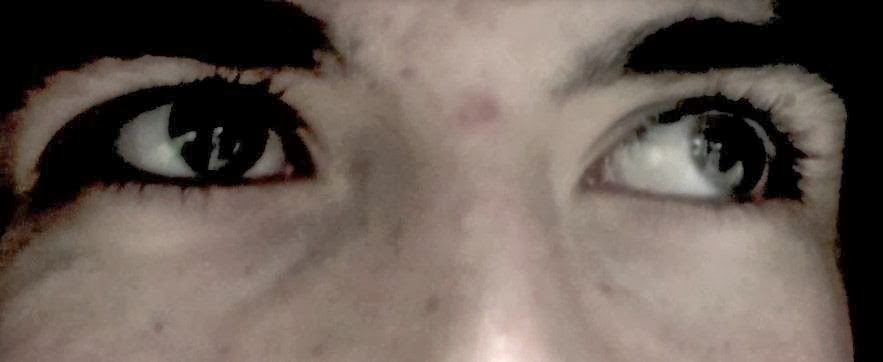
In the shot below (a close up of our character's eyes) we try to convey in the mise en scene that his smiling eyes (connoting happiness and excitement) show he has selected a victim. We create sympathy for the victim as she is unaware and the stereotype is complete as the main character has no mercy or sympathy. He is just evil. We use the stereotype to create anxiety in the viewer, which we then would play on later in the story. We would then make the reader feel sympathy for the character by making him more rounded and less of a stereotype.
Q1: In what way does your media product use, develop or challenge forms and conventions of real media products?
Overall, our film opening follows the conventions found in most thriller genre films. This helps our audience identify the exact genre that the film is going to be through the first 2 minutes. We drew inspiration from a range of films, but we mainly took a lot from the Eminem Music Video/Short Film - 3AM. This music video showed a varied amount of thriller codes and conventions which helped us come up with the whole idea for our film.

my conclusion to the question in hand is that our film follows a lot of thriller-genre codes and conventions to help the audiences recognise the style and genre of the film, identification is the main factor in film making, along side connectivity. the way that the audience feels when they watch the film, this is why we didn't use some of our ideas that we had for our film opening.
Used
| |
| youth. we decided to theme our film around Youth culture. so we gave our protagonist a black hoodie. this widens our audience because it also includes younger people to watch our film. the hood also represents darkness, the colour and the fact that it creates anonymity for the murderer. |
Wednesday, 15 January 2014
9 Shot
Eminem 9 shot


Here is our 9 shot analysis of Eminem's music video this is because there are many shots that are commonly used in a thriller.
Tuesday, 17 December 2013
Thursday, 12 December 2013
Moodboard
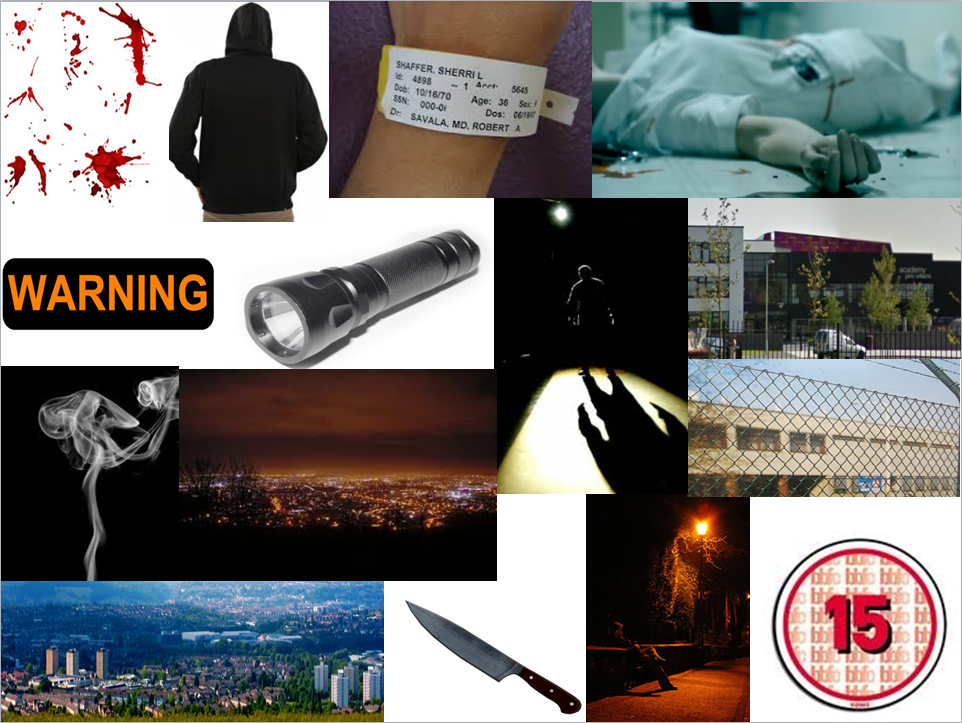
We have used the image of the 15 age rating, as this is the age that is appropriate for the viewer.
We have used the black hoodie as this is stereotypically linked with youths of today and this does not reveal the face of the character.
We have used the image of the kitchen knife as it is a good primitive weapon. The knife is iconic in the thriller genre so we are going to use it to annotate violence.
We have used the image of the torch as its a good source of low key lighting and is a great way of creating shadows and its a good way to build a tense atomsphere.
We have used the metal fence as it symbolises containment and security.
We have used the image of the dead body as this is a great shot of a dead victim and it only reveals the body of the victim.
We used the picture of the street light as it is a great way of building suspense as the face of the character is'nt revealed only, as the viewer can only see the hoodie from behind.
We have used the location shot of dundrey view as its a isolated location but has a great view over the city and at night it's a very dark place with a well lit city as the back drop.
We have used the image of the hospital wrist band as this is the way we are going to identify our suspect as this can be used to identify him.
We have used the image of the blood as this connotates death.
We have also used the image of the roof of the school building as this could be one of the possible locations.
We have used the image of the warning sign as it will be on the fence and will portray warning to the victim before the murder.
Tuesday, 10 December 2013
Codes and conventions of a thriller
Tuesday, 26 November 2013
Film Classification
AGE RATE
We have decided to rate our movie a 15 as this allows us to use violence but we also need to consider that teengaers are at risk of copying what they see.
What does the 15 symbol mean?
No-one under 15 is allowed to see a 15 film at the cinema or buy/rent a ‘15’ rated DVD. 15 rated works are not suitable for children under 15 years of age.Are there any limits on what sort of theme a work can have at 15?
 No theme is prohibited, provided the treatment is appropriate for 15 year olds.
What can a 15 contain?
strong violencefrequent strong language
discriminatory language or behaviour
drug taking
Can there be strong violence?
Yes, at 15 violence may be strong. It should not dwell on the infliction of pain or injury, however, and the strongest gory images are unlikely to be acceptable.Strong sadistic or sexualised violence is also unlikely to be acceptable.
Easily accessible weapons may not be glamorised.
What about horror works?
Many horror films are rated 15. At 15 there can be strong threat and menace (as long as it is not sadistic or sexualised), although the strongest gory images are unlikely to be acceptable.Can you see drugs in a 15 rated film or video?
At 15 drug taking may be shown but the work as a whole must not promote or encourage drug misuse.The misuse of easily accessible and highly dangerous substances like aerosols or solvents is unlikely to be acceptable at 15.
What about dangerous behaviour or things teens might copy?
We consider the risk of potential harm to impressionable teenagers. For example, dangerous behaviour such as hanging, suicide and self-harming should not dwell on detail which could be copied.
Sunday, 3 November 2013
Narrative Theories
Narrative Theory
Tzvetan Todorov
Tzvetan Todorov is a Franco-Bulgarian philosopher who writes books about literary theory, thought history and culture theory. Todorov believed that narratives were separated into 5 different stages.
He suggested that stories begin with an equilibrium (stage 1) where everything is in a normal state where any potentially opposing forces are in balance.
Stage 2: That there would then be some sort of disruption of the equilibrium.
Stage 3: A recognition that there has been a disruption.
Stage 4: An attempt to repair the disruption.
Stage 5: A reinstatement of the equilibrium.
Vladimir Propp
was a soviet formalist scholar who analyzed the basic plot components of Russian folk tales to identify their simplest irreducible narrative elements.Vladimir Propp broke up fairy tales into sections. Through these sections he was able to define the tale into a series of sequences that occurred within the Russian fairytale.
Vladimir Propp suggested that every narrative has eight different character types, these character types were:
The Villain - fights the hero in some way.
The Dispatcher - makes the villain's evil known and sends the hero off.
The Helper - helps the hero in their quest.
The Princess - acts as a prize for the hero.
Princess' Father - gives task to hero then gives the hero the reward.
The Donor - prepares the hero.
The Hero - reacts to the donor and gets the prize.
False Hero - tries to take credit for the hero's actions.
Claude Levi Strauss
Levi Strauss was a french anthropologist and ethnologist who studied hundreds of myths and legends all around the world, from that he found out that we as humans make sense of the world, people and events by seeing and using binary opposites.
Some examples of binary opposites:
Good v Evil
Black v White
Boy v Girl
Peace v War
Civilized v Savage
Democracy v Dictatorship
Equilibrium Theory
The equilibrium is a theory that the story is about a normal state being disrupted but then resolved to reinstate normality.
Thursday, 17 October 2013
Sound
Sound
Diegetic Sound - Sound that is part of the film, for example talking, weather and major events happening in the film.
Non-Diegetic - Sound we do recognise as part of the film world.
Sound Bridges - A sound bridge is a sound from one scene that will often continue onto the next scene.
Parallel - Compliments the image the viewer sees.
Contrapuntal - Sound that does not not fit the image.
Sting - Musical punctuation.
Theme - A key passage of music linked to the subject.
Incidental Music - "Background" adds atmosphere to the action.
Ambient Sound - Providing audio continuity between shots.
Sound Motif - Repeated sound that comes to be identified with a particular character, place or thing, we hear the sound and it adds axpectation.
Subscribe to:
Posts (Atom)